
Do you really need expensive equipment to make espresso at home?
- Growing interest in coffee consumer education has given way to a new wave of dedicated home baristas insistent on perfecting their espresso.
- According to the 2025 NCDT Specialty Coffee Breakout report, 43% of US adults enjoyed an espresso-based beverage in the past week, with 74% of past-day specialty coffee drinkers preparing their drinks at home.
- Traditionally, making espresso at home meant investing in bulky, costly equipment, preventing many people from experiencing coffee in different ways.
- But today, new technology and product design mean portable espresso machines are making a wider range of coffee drinks more accessible.
For decades, home espresso has been synonymous with substantial investment. Sizeable, expensive espresso machines and grinders take up significant counter space, and it takes time and effort to develop the technical knowledge required to dial in the perfect shot.
As a result, espresso has long been seen as a pursuit reserved for the most dedicated coffee enthusiasts. However, as brewing technology evolves and consumer needs shift, manufacturers are challenging this assumption.
While some argue that authentic espresso demands traditional equipment, recent innovations are making espresso-based drinks more accessible at home. Portable espresso machines have evolved into sophisticated brewing devices that offer consistency and precision.
Cédric Gobber at Wacaco and Brodie Vissers at Journee Studios explain more.
You may also like our article on the history of the espresso machine.

Why are more people making espresso at home?
The Covid-19 pandemic fundamentally reshaped the consumer relationship with coffee. With cafés closed and working from home becoming the norm, many found themselves investing in equipment, high-quality beans, and education to recreate café-quality drinks in their own kitchens.
“During the Covid-19 lockdowns, many people were confined at home, often in small apartments with limited access to outdoor spaces,” explains Cédric, the design manager at Wacaco, a coffee equipment manufacturer. “Cafés and restaurants were closed, and office espresso machines were unavailable, making a good cup of coffee a missed pleasure.”
But what began as a necessity evolved into a genuine interest for many coffee drinkers. Espresso consumption is rising in markets like the US, where filter coffee has long dominated. This shift has created a new generation of prosumers – those who seek to prepare professional-grade coffee themselves – who want to experiment with extraction parameters and brewing techniques.
“Espresso has something beautifully simplistic yet ambitiously complex about it that I believe gets people’s attention,” says Brodie, the founder of Journee Studios and a coffee and beverage content creator.
“In 2020, obviously, the market for home espresso machines exploded as people were seeking this same experience without leaving the house, and it particularly attracted the tinkerers and collectors – people who love using their hands, getting into the nitty-gritty, testing, experimenting, and of course serving others a carefully crafted drink.”
The universal popularity of milk-based beverages is also spurring more people to make espresso at home, particularly as customised drinks trend across social media platforms.
The visual appeal of latte art and creative signature drinks has encouraged more people to experiment, transforming espresso-making from a specialised skill into an aspirational home-barista activity.

Traditional espresso equipment has been a barrier
Despite growing interest, making espresso at home traditionally requires two significant investments: a home espresso machine and a quality grinder. Entry-level setups can easily exceed several hundred dollars, while prosumer equipment often costs thousands. For many, these costs make home espresso simply inaccessible.
Portable espresso machines, however, are disrupting this paradigm. They represent a new category of brewing device that delivers espresso without the bulk or price tag of traditional machines.
Accessibility extends beyond just price, however. These machines lower the technical barrier to entry, allowing newcomers to achieve quality results while still offering enough control for experienced users to refine their technique.
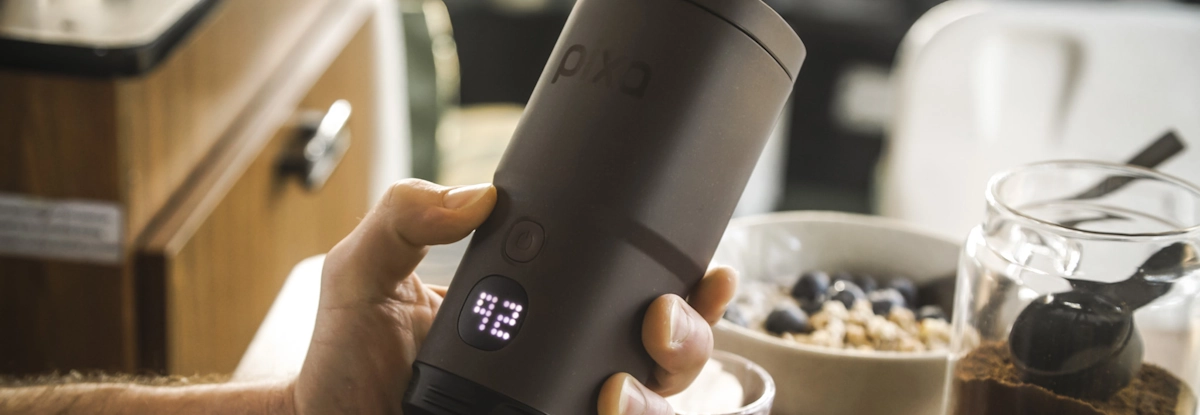
“The Pixapresso, for example, makes espresso more accessible by delivering an experience that suits a wide range of users – from complete beginners seeking a simple, one-button coffee solution to curious coffee enthusiasts who want to explore extraction parameters,” says Cédric.
Innovation in portable espresso machine technology means people can now make espresso at home without bulky or expensive equipment, and the quality increasingly rivals that of espresso made with traditional machines. These devices employ similar pressure systems and temperature control as their larger counterparts, but in more compact formats.
“Although full-scale espresso machines look beautiful on your coffee counter at home (if you have the space), they are quite expensive, heavy, and require a considerable amount of energy,” Brodie notes. “With the Pixapresso, you get the best of both worlds, where it’s not only much more affordable, it’s compact enough that you can use it literally anywhere.”
He explains that the machine features a fast heat-up time, brew cycles of up to 180 seconds, a 120ml water tank, an intuitive touchscreen interface, and three-level temperature control. These features offer precision and consistency – both essential for high-quality espresso extraction.
Pressure is also essential to extract true espresso. While some manual filter brewers can produce espresso-style, shorter beverages, they can’t generate enough pressure to achieve the distinctive texture, flavour, and crema of espresso.
The Pixapresso 20-bar pump, for instance, is engineered to deliver consistent pressure for espresso extraction. The machine also features a pre-infusion setting to facilitate even extraction and minimise channeling.

Portable espresso machine technology will continue to evolve
The barriers that once separated casual coffee drinkers from dedicated enthusiasts are disappearing as portable espresso machines encourage more people to experiment.
This new level of accessibility means quality espresso is no longer confined to expensive home setups or cafés.
But portable espresso machine manufacturers continue to face an ongoing challenge: how to stay innovative while competing with traditional machines. For many, the solution lies in offering unique value propositions that countertop machines can’t match.
“Wacaco has been designing portable espresso machines since 2013, giving us over a decade of experience refining and perfecting our brewing technology,” Cédric explains. “Each generation of our products is an opportunity to re-engineer every component to deliver greater stability, reliability, and overall user satisfaction.”
The Pixapresso exemplifies this approach with dual brewing compatibility for both ground coffee and Nespresso capsules. Its patented adjustable coffee basket can hold doses between 8g and 16g to prepare a range of drinks, while a replaceable battery system reduces waste and extends the product’s lifespan.
As coffee shop prices continue to climb, the trend of preparing coffee at home or on the go is likely to keep growing. Deloitte’s first-ever global coffee study for 2024, which surveyed 7,000 consumers across 13 countries, reveals that 55% of people say price hikes have pushed them away from out-of-home coffee.
For years, on-the-go coffee brewing exclusively meant filter coffee – a practical option, but limiting for espresso drinkers. While some manual filter brewers can produce espresso-style, shorter beverages, they can’t generate enough pressure to achieve the distinctive texture, flavour, and crema of espresso.
Recent technological breakthroughs, however, have enabled espresso preparation while travelling and commuting, as well as on hiking and camping trips.
“Using the Pixapresso has been a natural continuation in my nomadic coffee journey,” Brodie tells me. “I have used Wacaco gear since biking across Spain back in 2016 with the early Minipresso, and the latest machine has only improved my on-the-go coffee experience.”
The future of portable espresso machines may bring smarter integrations, enhanced precision, and advanced materials that further improve usability and extraction quality. Yet the core principle remains: making excellent espresso accessible regardless of location or budget.
“I think the biggest shift is accessibility, both financially and nomadically,” Brodie adds. “When you can get a solid setup that you can move with easily, like the Pixapresso, Exagrind hand grinder, and Exagram scale for a reasonable price, it’s a no-brainer for the espresso curious.”

The question of whether you need expensive equipment to make espresso at home is being answered by technology itself. While traditional machines will always have their place, portable espresso makers are proving that quality extraction doesn’t require substantial investment or counter space.
For those curious about espresso, these devices offer an accessible entry point that doesn’t compromise on the fundamentals of good coffee – and the freedom to enjoy it at home or on the go.
Enjoyed this? Then read our article on whether crema is always necessary for excellent espresso.
Photo credits: Wacaco
Perfect Daily Grind
Please note: Wacaco is a sponsor of Perfect Daily Grind.
Want to read more articles like this? Sign up for our newsletter!
Bhavi is a brand-building specialist, a dairy technologist, and a storyteller with a keen interest in coffee.


