
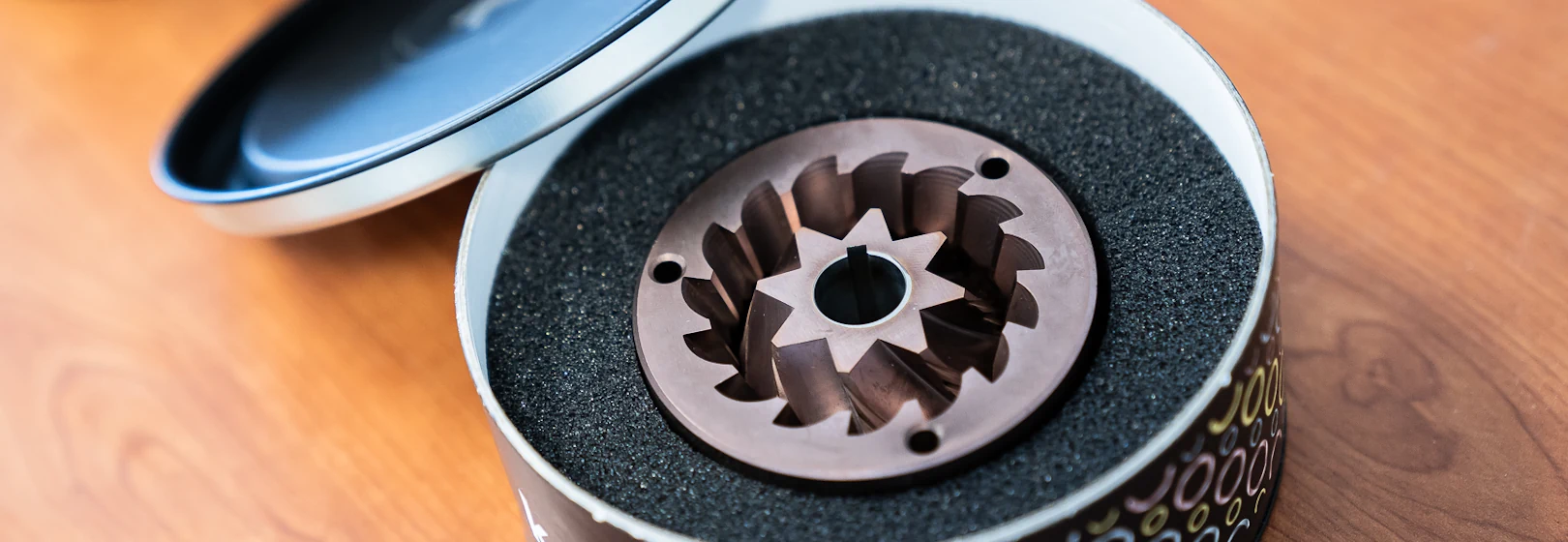
How grinder burr design is evolving
- Burrs are the powerhouse of any grinder, providing a consistent particle size distribution to brew excellent coffee.
- Baristas and prosumers constantly demand innovation with their grinders, and manufacturers are responding by focusing on burr shape and design.
- Materials and finishes are also becoming more important, prolonging equipment lifespan and enhancing performance.
- As burr design becomes more precise, customisable, and sophisticated, the potential to unlock new coffee experiences for both espresso and filter increases.
Today’s specialty coffee consumers and professionals demand nothing less than precision and consistency. As brewing techniques become more sophisticated and palates more discerning, the role of grinding technology has never been more critical.
Grinder manufacturers must keep pace with broader industry innovation, and burr design is often their primary focus. The shape, material, and size of burrs all have a huge impact on particle size distribution, dictating the quality of extraction and flavour.
As our understanding of extraction becomes increasingly scientific, the evolution of grinders becomes crucial to preparing better coffee. At the heart of this lies a fundamental truth: exceptional coffee begins with excellent burrs.
To learn more about how burr design will continue to evolve in the future, I spoke with Marco Tesconi, Cimbali Group Grinder Category Manager and Global Business Development at Keber Burrs.
You may also like our article on how espresso machine technology is becoming more advanced.

Why grinder burrs are essential for preparing excellent coffee
Among coffee professionals and prosumers, a widely accepted hierarchy of equipment importance exists – and the grinder consistently ranks at the top.
It plays a crucial part in the brewing process, dictating the size and shape of ground coffee particles prior to extraction. The burrs are the driving force behind this process, and their design determines everything that follows.
“Burrs are where the transformation begins, from whole bean to brew-ready coffee,” explains Marco, Group Grinder Category Manager at Cimbali Group, a premium coffee equipment manufacturer – which owns the brands La Cimbali, Faema, Slayer, and Casadio – and Global Business Development at Keber Burrs. “Their shape, material, and finish determine how consistently the coffee is ground, which in turn affects extraction, flow rate, and flavour clarity.”
The impact of burr design on particle size distribution cannot be overstated. Poor burr geometry creates an inconsistent grind size; fine particles will over-extract and result in bitterness, while larger particles remain under-extracted, contributing astringency and sourness. This creates a muddy, unbalanced cup where the coffee’s inherent characteristics are masked rather than highlighted.
Conversely, well-engineered burrs produce a narrower particle size distribution that allows for even extraction across the entire coffee bed.
“A well-designed burr set ensures that every particle is the right size, reducing the risk of bitterness caused by uneven extraction or overheating during grinding,” Marco tells me. “A precise burr design preserves the full aromatic potential of the coffee, and helps baristas deliver a repeatable, high-quality experience every time. It’s also important to decide which type of coffee you want to brew – espresso or filter – in order to know which grinder to buy.”
For both recipes, heat generation during grinding presents another critical factor. Inferior burr materials or poorly designed cutting edges create excessive friction, which can volatilise delicate aromatic compounds before they even reach the brewing vessel. The result is coffee that tastes flat and lacks the vibrant characteristics that define specialty-grade beans.
Without high-quality burrs, even the most expensive coffees and sophisticated brewing equipment cannot achieve their potential. The grinder then serves as the critical link between the promise of coffee excellence and the final results in the cup.

How manufacturers are innovating with burr design
As specialty coffee standards continue to rise, leading manufacturers have recognised that burr innovation must be their primary focus. This realisation has driven strategic decisions that fundamentally reshape how grinding technology develops.
One example is Cimbali Group’s acquisition of Keber, a Venice-based specialist burr manufacturer, in 2019. This merger enabled both brands to expand their production capacity and leverage their shared expertise.
“Keber has been a key player in burr innovation for over three decades,” Marco explains. “With full in-house production in Venice, we combine metallurgical expertise, precision engineering, and an artisanal mindset to create high-performance burrs.”
Rather than producing one-size-fits-all solutions, Keber’s expertise allows for burrs tailored to specific applications, roast profiles, and flavour outcomes. This approach represents a fundamental shift from commodity manufacturing to precision engineering.
Over the past decade, several key trends have emerged in burr design evolution. Perhaps most notably, flat burrs have gained significant ground in the prosumer and home espresso segments, markets traditionally dominated by conical burr grinders. This shift reflects consumers’ growing sophistication and desire for the precision and control that flat burrs typically provide.
The migration toward flat burrs in home and prosumer grinders also aligns with broader trends in specialty coffee. As more consumers attempt to replicate café-quality espresso at home, they are seeking the same level of control that professional baristas enjoy. Flat burrs, with their typically more uniform particle distribution, offer the consistency necessary for dialling in espresso parameters with precision.
Material innovation has proceeded alongside geometric advances. Premium alloys and specialised coatings now extend burr lifespan while reducing retention – the amount of ground coffee that remains in the grinder between uses. Lower retention means fresher coffee and less waste, particularly important for single-dosing workflows, which are popular among home enthusiasts and high-end coffee shops.
“We experiment with advanced alloys and coatings that not only extend lifespan but also support specific flavour profiles,” Marco says. “It’s this level of customisation that allows Keber to push the boundaries of grind quality across espresso and filter applications.”
These material advances have practical implications beyond longevity. Smoother burr surfaces reduce excessive particle friction during grinding, preserving more volatile aromatic compounds. The result is coffee that retains more of its original characteristics, allowing subtle flavour notes to shine through rather than being masked by grinding-induced defects.
Led by Marco Tesconi and Alessandro Giammatteo, a coffee specialist and consultant at AJM Coffee, Inside Keber is a factory tour that offers an exclusive look at how the company manufactures professional burrs for espresso and filter coffee.
The tour reveals how every detail of burr design directly influences extraction, aroma, and cup quality – from design and material selection to surface treatments and particle size analysis.

How the grinder market will continue to evolve
The trajectory of grinder innovation continues to accelerate, driven by increasingly sophisticated consumer expectations and technological possibilities. Manufacturers must then anticipate market trends while developing products that can adapt to evolving brewing preferences.
“Our goal is to align technical precision with real-world usability,” Marco explains. “With grinders like the Ermes Dual by Casadio, we have developed burrs that are not only efficient in avoiding excessive friction between the coffee particles, but are also optimised for both espresso and filter.”
The expanding prosumer market demands this level of sophistication. Today’s coffee enthusiasts expect commercial-grade precision in compact, ergonomic models. They want the ability to dial in grind settings with micron-level accuracy, store multiple recipes for different beans or brewing methods, and achieve consistency that rivals their favourite café.
Grinders like the Casadio Ermes Dual exemplify this forward-thinking approach to burr design. The grinder’s vertical 75mm steel burrs, developed by Keber, minimise retention and enable users to transition between espresso and filter through advanced distance detection technology that measures burr separation in microns.
The touchscreen display represents another evolution in the user experience. Rather than requiring baristas to memorise adjustments to grind size, the interface provides real-time feedback on grind settings and allows storage of up to five custom recipes.
Looking ahead, Marco anticipates even greater customisation in burr design.
“The next frontier of burr design will centre on personalisation and sensor integration,” he says. “We will see burr geometries tailored to specific roast profiles, origin characteristics, and desired flavour outcomes, especially as demand grows for lighter roasted coffees.
This evolution toward smart, adaptive grinding systems will likely incorporate real-time monitoring of output and burr wear, automatically adjusting parameters to maintain consistency throughout the grinder’s lifespan. Integration with other coffee equipment – particularly espresso machines – through technologies like Bluetooth connectivity will also facilitate coordination between grinding and brewing parameters.
However, technological advancement must remain rooted in fundamental mechanical excellence. “The grinder of the future will be a smart, adaptive system, but always grounded in precise mechanical craftsmanship,” Marco emphasises.
As the specialty coffee industry continues to mature, the role of grinding technology becomes increasingly central to the overall coffee experience. Manufacturers who prioritise burr innovation while maintaining focus on user experience will help define the next generation of coffee preparation.
“We believe grind size is the most overlooked variable in coffee, yet it is the point where flavour is either protected or lost,” Marco concludes. “By investing in burr quality, baristas can significantly elevate the cup without changing beans or brew method.”

The evolution of burr design goes beyond technical innovation; it reflects the industry’s commitment to unlocking the full potential of specialty coffee.
As standards continue to rise and consumer expectations grow more sophisticated, the grinders that succeed will be those that treat burr design not as a component, but as the foundation upon which great coffee is prepared.
Enjoyed this? Then read our article on how the home espresso machine market is evolving.
Photo credits: Cimbali Group
Perfect Daily Grind
Please note: Cimbali Group is a sponsor of Perfect Daily Grind.
Want to read more articles like this? Sign up for our newsletter!

Bhavi is a brand-building specialist, a dairy technologist, and a storyteller with a keen interest in coffee.


